

How to navigate an organisational culture change
Culture is a curious thing…
Organisational culture is a strange entity – like a twisting wraith in the wind. It has always been there, even when no one talked about it.
A Victorian printworks tucked behind Fleet Street in 1856 had a culture, though it wouldn’t have known it. Working there would have felt different to working at the printworks around the corner, but it wasn’t something anyone worried about.
Today, we expect more from culture. We measure it, change it, blame it. Yet it remains elusive. However robust it seems, it only takes a couple of months of poor results or psychological unsafety to damage it beyond repair.
It shifts automatically when leadership changes. It is, in many ways, fragile – like a sputtering flame. But it also has a mind and will of its own. That’s why, when change is required, subtle shifts demand heavy machinery – metaphorically speaking. And patience. Always patience.
Where leaders focus – and what they often miss
Business leaders often latch onto culture through the lens of performance:
- Are people working hard enough?
- Do they have the skills required to do a good job?
- Are they making good decisions?
- Do they take responsibility?
These are cultural questions, but only part of the picture.
Organisational culture includes both what is visible and what is hidden; both what is deliberate and what is taken for granted. This echoes Professor Edgar Schein’s model of culture, which remains one of the most useful ways to make sense of it. He described culture as having three layers:
- Artefacts: The visible, tangible expressions of culture.
- Espoused values: What the organisation says it believes in.
- Underlying assumptions: The unconscious, taken-for-granted beliefs and habits that truly drive behaviour.
What happens to culture after an acquisition?
When a new owner steps in, culture will shift whether intentionally or not.
A new person at the top – even a slightly removed Chair – immediately influences culture. It begins with how they speak. How they lead meetings. How they make decisions. Even how they use their diary. It’s not always intentional, but it’s always influential.
I once turned down a lucrative project for this reason. The leader of the business in question made it clear he wasn’t interested in being involved. The team wanted to assess and eventually evolve the culture. But the chairman said, “Go ahead – I don’t want to participate.”
I backed away. Why? Because he was the culture. There was a palpable sense of fear when people referred to him. Not the sort of fear that blocks a tricky, but possible change – I’ve handled that before – but a deep, paralysing reluctance. “I’m not going to change, but you can,” was the message. And that doesn’t work. Culture flows from the top.
When a new leader acquires a business, there are a few typical scenarios that play out. Let’s look at three:
Scenario 1:
The culture isn’t working and you’re itching to fix it
First, ask yourself: “Not working how?”
We often judge a failing culture by its symptoms:
- High sickness absence
- Too much (or too little) staff turnover
- A flat, lifeless atmosphere when you walk into the office
All these things matter. But the impulse to rush in and shake things up – to inject energy and ambition, for example – can be hard to resist. You must resist, if you want to avoid months of unnecessary pain.
Two things need to happen first:
- The top needs to shift quickly
- You need to map what’s already there
Start by setting the tone at the top
Put your efforts first into creating meaningful relationships with your senior leadership team. If you’re naturally charismatic, you may establish your preferred working dynamic through day-to-day practice. If you work more through quiet influence, plan your interactions carefully to benefit the group, not just yourself.
Focus on:
- Setting up meetings, including both regular and ad hoc gatherings
- Establishing clear agendas and expectations
- Wrapping meetings up with next steps / calls to action
- Style of interaction (formal/informal, hierarchical/flat)
- Language used (direct/indirect, formal/parochial)
These things matter. They are small habits and signals that form the rituals of your leadership. Get them working in your favour early.
Then take stock of what you’ve inherited
Some argue the culture will change automatically just because you’ve arrived. And it will to an extent. But you may want to preserve elements of the existing culture that aren’t “you”, but still serve the business. Your job is to discern what’s worth keeping.
If a stated culture already exists, test its accuracy. You can do this informally through SLT conversations and chats with a cross-section of staff. If no formal culture is defined, bring someone in to help you capture it. Different practitioners take different approaches, but here’s a general guide:
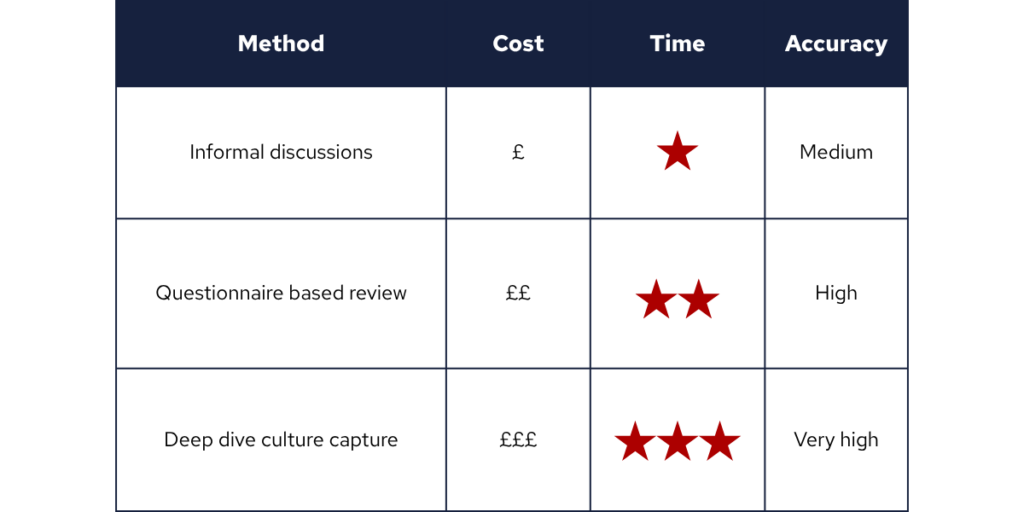
Your choice depends on what outcome you want. If you’re planning to overhaul the team, a deep-dive may be excessive. But if your aim is to retain and motivate, then a more rigorous approach can send a clear signal: we care about who you are and what you’ve built.
This is your moment to engage, not just diagnose. Listening well builds psychological safety, trust, and early alignment.
The culture you want must build from what you have
It’s rare to find nothing worth keeping. Often, there are elements the team values in each other – collaboration, humour, informality – that are invisible from above but deeply embedded.
Your job is to surface what should stay and get crystal clear on what must go. Not vague ideals, but specific habits, rituals, behaviours or norms that need to shift.
But even now – don’t announce your culture.
Your next step is to draft a cultural proposition, not dictate one. Share it. Contrast it with what came before. Invite comment. The more people can see where they’ve already contributed to this version, the more likely they are to back it.
Scenario 2:
I bought the business because I loved the culture
This sounds like a “do nothing” scenario. But if left alone too long, it can turn into a frustrating, friction-filled experience – for you and others.
The way a new CEO works with their SLT will shape the business whether you mean it to or not. Tiny habits ripple. Even just running meetings with an agenda and clear actions at the end might feel like a cultural revolution to some. It’s a small symbol – but it says, “we do things differently now.”
If left unexamined, these differences can quietly undermine the culture you loved.
Six months in is a good point to reflect. Ask:
- Does the stated culture still reflect reality?
- Where are the subtle gaps or frictions?
- What have I introduced without realising?
This isn’t about imposing anything. It’s about taking stock and choosing whether to codify what’s good, or nudge what’s missing. Quiet, deliberate reinforcement is your best friend here.
You will know if there are frictions, but you shouldn’t think that the old culture has been wiped out. Grab a team of trusted people who represent the entire organisation and task them with examining the culture for you. Be honest about the aspects you really like. They will be able to see what’s changed, what’s stayed the same, and should be able to help you to relaunch the culture in an honest, purposeful manner.
Scenario 3:
I want to bring in my own culture
This is the most visible and decisive shift and it can work well when done thoughtfully. However, done carelessly, it risks driving out your best people and demoralising the rest.
Don’t skip the baseline. Even if you’re determined to replace what came before, don’t skip the discovery work. A questionnaire or cultural audit gives you a clear starting point. You’ll identify overlaps – and you need those, because the moment you start “teaching” people what they already know, you lose credibility.
Ask your culture lead (internal or external) to look for synergies. Are there things already done well in your new business that align with the culture you’re bringing? Are there elements that need just a small nudge?
Before doing any big ta-da about your entirely new way of working, it really pays to find synergies. This approach acknowledges that not everyone in a struggling business is underperforming. More importantly, it shows respect. And that matters, practically and ethically. Because when adults are treated like naughty children, strong performers will leave. You’ll be left with the under-confident (some of whom may shine) and the disengaged (who likely won’t).
Culture is changed by what you do – Not what you say
A culture statement is not a culture. It’s a shared story, a helpful shorthand, and hopefully something the team feels proud of. But it doesn’t do the work.
What changes culture is structure and habit. That’s why your early working norms with the SLT are already changing the business, whether you intend it to or not.
Use your internal systems as your culture-change toolkit:
- Performance management: What gets noticed and rewarded
- Recruitment processes: Who joins and why
- Learning programmes: How people grow
- Communication systems: From newsletters to meeting style, email tone, apps, and how the handbook looks and feels
These aren’t admin. They’re symbols. They’re rituals. And they speak louder than your values page. Just telling people to be different is extremely damaging. Giving them the opportunity to grow is quite the opposite.
A final note on sharing your culture
Once your changes are well underway – and you’ve blended the culture with your own strong flavour – it’s time to produce, share and celebrate the culture that now exists.
But a statement of culture is a tricky beast. It has to capture both the spoken and unspoken; something that feels real, not just well-worded.
I’ve seen plenty of culture statements made up of carefully crafted sentences, refined through many iterations until they’re absolutely perfect. And in that perfection, something vital gets lost: clarity, energy, character.
Take this example from Netflix:
At Netflix, we aspire to entertain the world, thrilling audiences everywhere. To do that, we’ve developed an unusual company culture focused on excellence and creating an environment where talented people can thrive – lifting ourselves, each other, and our audiences higher and higher.”
What, exactly, is “unusual” about focusing on excellence and talented people thriving? Do they dress up as clowns on Fridays and eat cheesy nachos through clowny red mouths? Now that would be unusual.
Or is the implication that only Netflix cares about excellence? It’s hard to say – and harder still to feel what it would be like to work there, based on that statement.
Here’s a better example, from Twilio:
We build for better, together. Twilio culture runs on creativity, diversity, and positivity. That’s because our mission is to unlock the imagination of builders, including our own. We cultivate an inclusive space where all feel welcome, celebrated, and contribute meaningfully as we build great things together.”
There’s more substance here. You get a sense that creativity and continuous improvement are genuinely valued. But still it reads a little like marketing copy rather than a lived truth. There’s a gap between aspiration and atmosphere.
Say less, mean more
In my view, the strongest expressions of culture are simple, distilled, and human. A small set of single words or phrases that reflect both:
- The qualities of the people in the team
- The standards and aspirations of those who lead
Yes, each word is open to interpretation. But once you see a cluster – six, maybe eight – the ambiguity narrows. Patterns emerge. Personality shines through.
And importantly, you don’t risk alienating people through clumsy inclusivity clichés. A word like authentic, curious, or individual can say far more about a welcoming culture than simply naming what’s already expected in most professional contexts. Don’t threaten people with diversity – show them that difference is welcomed instead.
Anchor it in reality, not rhetoric
Your culture actually lives in the processes, habits and everyday interactions that underpin your business. If those have changed – if your SLT now leads differently, and those changes have cascaded through the organisation – then the culture has changed.
That’s the point when you can confidently describe what’s really there.
So keep your culture statement simple. Let it capture what’s true and make sure it’s backed by the intricate, thoughtful work you’ve already done behind the scenes. Culture will continue to evolve, but this moment of articulation matters.
It marks the point where purpose, people and practice meet.